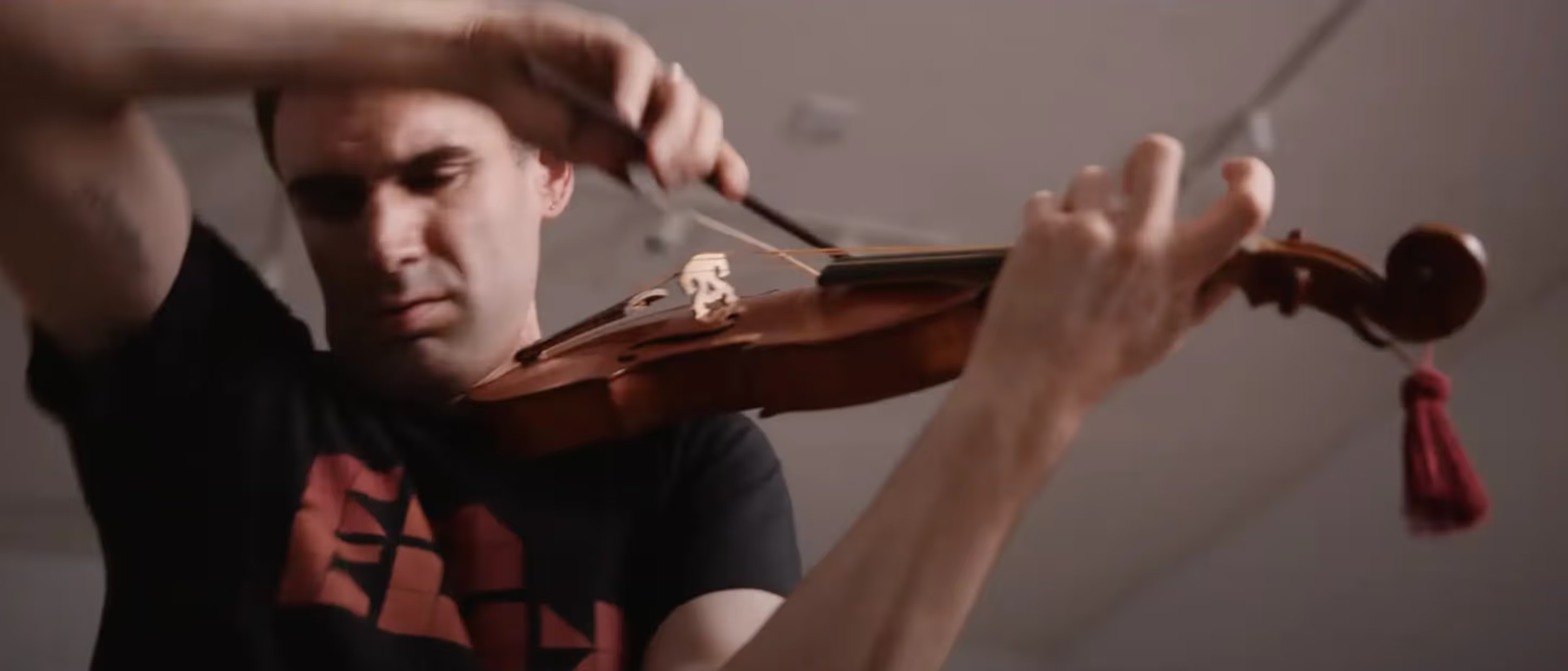
“Violinist Nicholas DiEugenio played with rapturous poetry.”

Nicholas is in-demand as a soloist, chamber musician, and ensemble leader, creating powerful shared experiences in music ranging from early baroque to contemporary commissions. A core member of the Sebastians, a period group hailed as “topnotch” by the New Yorker and “sharp-edged and engaging” by The New York Times, Nicholas also performs and records with pianist and wife Mimi Solomon.
News

Nicholas DiEugenio collaborates to bring Gabriella Lena Frank to North Carolina
Gabriela Lena Frank headlines the Festival on the Hill with the North Carolina premiere of her Conquest Requiem

From Poland With Love!
Nicholas DiEugenio teams up with his wife and artistic partner pianist Mimi Solomon and travels to Poland on an ERASMUS exchange

Nicholas recaps an inspiring 25-26 concert season!
2026 was a whirlwind of inspirational festivals, concerts, and collaborations!
Latest Album
Unraveling Beethoven
New Commissions for Violin and Piano of Allen Anderson, D.K. Garner, Robert Honstein, Jesse Jones, and Tonia Ko
SEE album details
Upcoming SHOWS
October 31, 2026
5 pm
Sebastians in NYC
In honor of Halloween, the Sebastians explore the darker side of the Baroque. From Bach’s dramatic D minor Toccata and Fugue and Tartini’s legendary Devil’s Trill Sonata to musical portraits, storms, ghosts, and follies, this program uncovers the strange and theatrical imagination of the eighteenth century—a world where virtuosity, mystery, and storytelling meet.
November 6, 2026
7:30 pm
To Beethoven Rather Than To Seem Part 2
This season, Gut Instinct takes on the large-scale project "To Beethoven Rather Than To Seem," marking 200 years since Beethoven's death and 250 since the U.S. Declaration of Independence. Over the course of five concerts, Nicholas DiEugenio and pianist Mimi Solomon will present all ten Beethoven Sonatas on period instruments along with five commissioned works written expressly for them. This concert, Part II, includes Allen Anderson's Linen along with Beethoven's op. 30 nos. 1 and 2.
November 21, 2026
5 pm
Sebastians in NYC
Following our acclaimed one-voice-per-part performance of Bach’s Mass in B minor, the Sebastians return to the music at the heart of Bach’s career: the church cantata. Featuring two of his most beloved masterpieces—Wachet auf, ruft uns die Stimme (BWV 140) and Ein feste Burg ist unser Gott (BWV 80)—this program offers a rare chance to hear Bach’s sacred music with the transparency, intimacy, and expressive power of four individual voices, creating a sound world remarkably close to what Bach himself likely heard in Leipzig.